How to write a D&D character backstory
Six complete examples by race and class, the Knife Theory framework, and every mistake worth avoiding before you put pen to parchment.

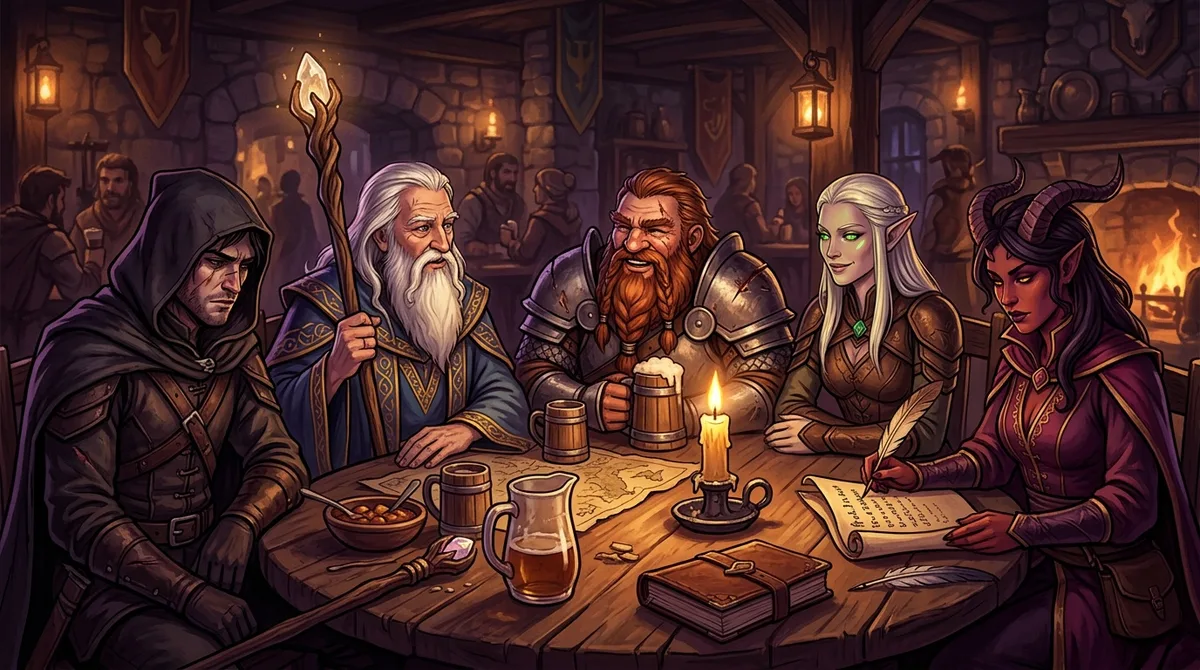
Most backstory guides hand you a list of questions - where were you born, do you have siblings, what's your greatest fear - and leave you to fill them in yourself. Then you write three paragraphs and wonder why your DM never references any of it.
The problem isn't the questions. A backstory isn't a form to fill out. It's a negotiation between you and your DM about what kind of story you're going to tell together.
This guide explains the framework that makes backstories actually useful at the table, and then shows you what six finished ones look like across different races, classes, and tones. By the end, you should be able to write yours in an afternoon.
50M+
TTRPG players worldwide
RPG Drop, 2024
$2.15B
Global TTRPG market size
Industry Research Biz, 2025
70%
Active players in weekly sessions
Market research, 2024
38%
Players aged 18-35
Market research, 2024
What a backstory is actually for
Your DM is running a living world. They're tracking dozens of NPCs, faction relationships, geography, economics, and whatever chaos the last session introduced. When you hand them your backstory, you're not filing paperwork. You're handing them raw material.
A backstory that works is full of what the D&D community calls "knives" - a term coined by a redditor named jimbaby in a thread that got passed around for years. Knives are anything the DM can use against you in the good way: a person you care about, an enemy who isn't finished with you, a mystery you don't have the answer to, an obligation you haven't fulfilled. The DM takes those knives and, at some point during the campaign, stabs you with them. That's what makes moments feel earned.
A backstory without knives is a sealed room. Your character arrives fully formed and emotionally resolved, which means the DM has nowhere to go except your character's general moral code. That works, but you're leaving a lot on the floor.
Aim for five to eight knives. They can look like: an NPC who is still alive and has strong feelings about your character; a faction that wants something from you; a question your character is genuinely trying to answer; a failure you haven't made right; a place you can't go back to; a secret that would change how people see you.
Tip
Write your backstory after you've chosen your race, class, and background - not before. The mechanical choices are free worldbuilding. A Tiefling Paladin is already a backstory waiting to be written: why is someone burdened by infernal heritage devoting themselves to a divine oath? That tension is the character.
How long, and what format
Two pages is the upper limit anyone will actually use. One page is better. A half-page summary that your DM can glance at mid-session is best. Some players write a longer personal version and distill a short one for their DM - that works fine.
Write in past tense, and write it as a person looking back on events rather than as a narrator describing a life. "I was seventeen when the barracks burned" lands differently than "At age seventeen, Aldren experienced a formative tragedy." The first is a character speaking. The second is a Wikipedia stub.
Don't over-specify things you don't need to. A backstory that describes every room in your childhood home, every teacher's name, what you ate on significant mornings - that's not depth, it's noise. Leave gaps intentionally. Some of your best sessions will come from the DM filling in something you left blank.
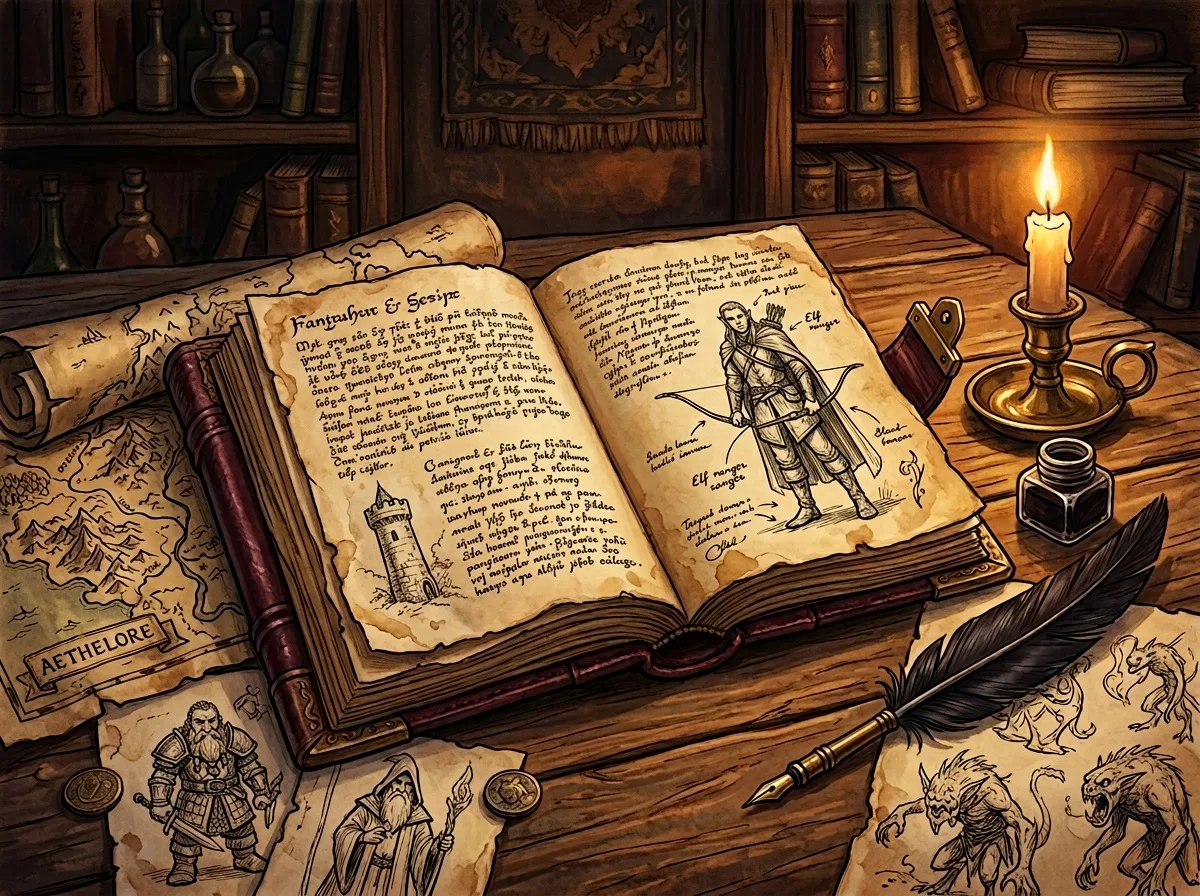
Six backstory examples (complete)
These are written as actual prose, not templates. Each covers a different race-class combination with a different approach to the same core arc: who you were, what broke open, where you landed, and what's still unresolved. The "Knives" line at the end of each is just a quick summary for reference - something like what you'd share in a note to your DM.
1. Human Fighter - Maren, the reluctant soldier
I fought for six years in the Thornwall campaigns. Not because I believed in the cause - I was sixteen when I was conscripted and didn't understand what the cause was yet. By the time I understood it, I'd buried four people I loved.
Captain Verik gave the order that got them killed. He said it was a calculated risk. It wasn't. It was bad math done by someone who wouldn't have to carry the bodies afterward. He's still a captain somewhere. I heard he made major.
I left the army when my contract ended. I didn't know what else to do with my hands so I kept fighting, just for different reasons and different coin. Somewhere in there, "protecting people" became the only motivation I understand. I'm not sure if that's noble or if I'm just trying to spend the debt I owe.
Knives: Verik (enemy, still active); the four dead soldiers (guilt, ghost of obligation); "protecting people" as a motivation the DM can put pressure on
2. Tiefling Warlock - Seren, the leveraged
My mother made the bargain before I was born. She was desperate - dying, in debt, carrying a child she couldn't afford to keep. She agreed to terms she didn't fully read. I came out with horns and eyes that glow in the dark, and a patron I never chose waiting for me.
I spent my adolescence pretending the magic wasn't there. I grew up in a city where everyone assumed the worst about Tieflings, and access to eldritch fire wasn't exactly helping my reputation. I tried to be invisible.
Then I got into trouble I couldn't get out of without using the power. The patron showed up in a dream that night and said, simply: "Now we have an understanding." Whatever the terms are, they're still unclear to me. That's deliberate on their end, I think.
I'm working toward leverage. Information, favors, relationships - anything that gives me standing when the patron finally calls the debt. I might not be able to renegotiate the terms. But I want to walk into that conversation with something in my hand.
Knives: The patron (obligation, terms deliberately unclear); the origin bargain (what exactly was promised?); the city that rejected them (enemies or uncomfortable history still there)
3. Wood Elf Ranger - Thalindra, the displaced
The Mirewood is gone. Not symbolically - it burned. A lumber consortium needed the land and hired mages to make sure the treeline didn't fight back. It took three days.
I was a warden. My whole identity was bound up in knowing every creek, every animal path, every hollow tree in a forest that no longer exists. When it ended, I didn't know what to do with the knowledge. I still catch myself thinking in terms of that specific geography.
I've been tracking the consortium for two years. Not to kill anyone - though the people who made the decision deserve whatever accounting comes for them. I want to know if the Mirewood can be restored. I've heard stories of druids who've brought blighted land back. I need to know if those stories are true.
In the meantime, I go where the work takes me. I'm good at moving through wilderness and finding things. Might as well use it.
Knives: The consortium (enemy, ongoing); the possibility of restoration (hope that can be crushed); identity stripped of its object (the "what are you for" question will come up)
4. Dwarf Cleric - Brodun, the uncertain
I was a priest of Moradin for twenty years. Then the Deepvein collapsed and took four hundred miners with it. We prayed for days. Nothing.
I don't think I stopped believing in Moradin exactly. More like I stopped believing that belief means what I thought it meant. The survivors needed something I didn't know how to give. I told them Moradin had a plan. I stopped being able to say it with a straight face around year two.
I left the temple. Not dramatically - I just stopped going back after a pilgrimage and let the silence stretch out. My order sends letters occasionally. I haven't opened the last three.
The magic still works. That's the part I can't resolve. If I'd lost the divine connection, I'd have an answer. But spells still function, which means either Moradin is still there and chose not to help four hundred people, or the magic is mine now and I've been wrong about how it works. Neither option is comforting.
Knives: The temple (wants them back, unresolved); the unanswered prayer (the central question - can be revisited through play); the fact that the magic still works (theological crisis that can deepen)
5. Half-Elf Rogue - Cael, the unclaimed
Human towns clock me as an elf. Elven communities clock me as human. I've stopped trying to correct either and started using the ambiguity as a tool.
I ran with the Hollow Hand guild for three years. Reliable work, and I was good at what they needed. I left when a job went wrong and someone I cared about took the consequence I should have. The guild doesn't forget, but they're not urgent about it - I owe them, and a debt they can collect on later is worth more than burning the asset now.
I'm trying to build something that doesn't depend on where I was born or who my parents were. A name people trust because of what I've done, not what I am. That's a longer project than I thought when I started. It requires a lot of choosing who to be in moments where the easier path is obvious.
The girl who took my consequence is alive and working somewhere in the eastern territories. She doesn't know I know where she is. I haven't decided yet what I want to say to her.
Knives: The Hollow Hand (debt, potential threat); the girl (guilt, open question); the project of building a name (motivation the DM can complicate)
6. Dragonborn Paladin - Rhovax, the last credit
The Keth Kauldur clan surrendered at the siege of Embervast. I wasn't there. I was nineteen and posted to the northern pass, doing exactly what I was ordered to do, two hundred miles away. It doesn't matter. In the eyes of the clans, the Keth Kauldur surrendered, and I am Keth Kauldur.
My oath came after the disgrace, not before. Pelor's justice doesn't care about bloodlines. That's partly why I chose it. I need to operate in a framework where what I do matters more than where I come from.
There are people who argue the surrender wasn't cowardice - that the commander had information the rest of us didn't, that it was the right tactical call. I don't know if I believe them. I'm not sure it matters. What matters is that the disgrace is real and the only thing that's going to move it is enough deeds stacked on the other side.
I'm aware this might be impossible. I do it anyway.
Knives: The clan (some want redemption, some want nothing to do with them); the commander's secret (was the surrender actually right?); the oath (the DM can present situations that strain it)
Human Fighter
Soldier background
Maren is built around guilt and a simple motivation - protect people - that the DM can stress-test by putting her in situations where she has to choose who gets protected.
Tiefling Warlock
Outlander background
Seren's power came with conditions she didn't negotiate. The patron is the clearest knife: a relationship with unclear terms and an entity that is patient, strategic, and alien.
Wood Elf Ranger
Outlander background
Thalindra's loss is concrete and specific - a named place, a named perpetrator, a goal that might be achievable. That specificity makes the story usable.
Dwarf Cleric
Acolyte background
Brodun's crisis isn't "I don't believe in the gods." It's "I believe, and the math doesn't work." That's harder to resolve and more interesting to play through.
Half-Elf Rogue
Criminal background
Cael's identity conflict isn't treated as tragedy - it's something they've found a use for. The wound is there but they've moved through it to a strategy.
Dragonborn Paladin
Soldier background
Rhovax's honor arc is aware of itself: "this might be impossible, I do it anyway." That self-awareness makes the character harder to reduce to a simple type.
What separates a usable backstory from a sealed room
Every one of those characters is still in the middle of something. That's not an accident.
A backstory that resolves all its conflicts before session one has no dramatic surface. Compare "my village was destroyed and I avenged my family" with "my village was destroyed and the person I think is responsible is currently a respected merchant in the city where the campaign begins." The first is history. The second is a plot.
| Element | Sealed room | Open door |
|---|---|---|
| Central conflict | Resolved before play | Ongoing - develops during campaign |
| Key NPC | Dead or absent | Alive and has opinions about your character |
| The core question | Answered in backstory text | Still being answered through play |
| Motivation | Abstract ("find purpose") | Concrete ("track down the consortium") |
| Relationship to class | Incidental | Explains the class choice |
| DM hook count | 0-2 | 5-8 |
The open door backstory gives your DM material. The sealed room gives them nothing to work with.
Mistakes that hurt more than help
The dead parents opener isn't inherently bad, but it's so common that DMs are immunized to it. If your backstory starts there, you need to do more work to make it feel specific. What were the parents like as people? What's the complicated feeling that comes with the grief - relief? guilt? anger at the wrong person? Dead parents as a fact is nothing. Dead parents with texture is something.
The retired legend is trickier. Your character was a master assassin / former general / legendary mage before something happened and now they're a level 1 adventurer. This creates a tonal mismatch that never quite resolves. If you need a powerful past, anchor it to a narrow domain: they were the best lockpick in the city's thieves guild, not the best assassin in the realm.
The novel draft speaks for itself. Twelve pages of lore is love letters to yourself, not a DM resource. Write for the person who needs to run a session, not for the person who wants to worldbuild.
Ignoring your mechanical choices is a real missed opportunity. The Backgrounds system gives you free story hooks - proficiencies, equipment, a personality framework that already implies a history. If you're playing a Charlatan, your backstory should explain why you became one. If you're skipping the background entirely, you're leaving usable material on the floor.
Pure tragedy with no texture is the last one. A character who has only suffered is hard to play for a long time. The suffering should leave something behind besides the wound: a skill, a relationship, a way of seeing the world, a dark sense of humor. Brodun's crisis left him with the theological question. Cael's rejection left them with the ability to use ambiguity as cover.
Warning
Don't build a backstory that requires your DM to run a specific plot for it to matter. "My father was secretly a dragon and will eventually reveal himself" puts story obligation on your DM they didn't sign up for. Backstory elements work best when they can be activated by the world as it already is.
Writing for your specific race and class
The most overlooked source of backstory material is the mechanical tension between race and class. Certain combinations are interesting almost by definition because the in-world assumptions about those groups create friction.
A Tiefling Paladin is rare enough in-world that people notice. Why would someone touched by infernal heritage take a divine oath? That question is your backstory's spine. You don't have to answer it in the text - you can leave it as something your character is still working out - but you should acknowledge the tension exists.
The same goes for a Dwarf Ranger (someone who left the deep places to wander), a Halfling Warlock (patron relationships are unusual for a people known for simple contentment), or a Half-Elf Wizard (neither the lifespan advantage of elves nor the grinding ambition most arcane academies select for).
What would people in this world assume about someone like you, and how did you get here anyway? The gap between assumption and reality is often where the character actually lives.
A framework, not a formula
There's no right structure for a backstory. The template approach - "fill in your hometown, your family, your motivation" - produces characters that feel interchangeable because everyone uses the same container.
Better to start with one concrete thing that happened: a single event that changed the trajectory. Everything else is context for that event or consequence of it. For Maren, it's the order Verik gave. For Brodun, it's the cave collapse. For Thalindra, it's the three days the Mirewood burned. From that one specific event, the character radiates outward - who they were before, what they did in the aftermath, who they blame, what they want now.
An origin story doesn't need to be complicated. It needs to be specific enough to feel true.
Tip
If you're stuck, write one sentence that completes this: "Everything changed when ___." It doesn't have to be dramatic. It just has to be real to the character. Then write backwards and forwards from that moment.
Getting your DM involved
Show your DM a draft before you finalize anything. This isn't about asking permission - it's about checking compatibility. Does the setting have room for your backstory? Is the faction you're fleeing from an existing faction in the world they've built, or can they add it?
Most DMs will be grateful. It lets them plant seeds early instead of scrambling to react when your backstory elements surface during play.
A good DM will push back on things that could create problems: a backstory that requires the campaign to go a specific direction, or a motivation so all-consuming it might dominate every session, or a past so heavy it makes certain content uncomfortable. That feedback is worth hearing. Take it.
References and sources
- Arcane Eye - DnD Character Backstory Template - Knife Theory framework and template structure
- D&D Beyond - Creating a Backstory for Your First Character - official beginner guidance
- D&D Beyond - Roleplaying 101: Building a Backstory - background mechanics and personality traits
- RPG Drop - Worldwide TTRPG Market in 2024 - player count and market data
- Industry Research Biz - TTRPG Market Size - market projections and CAGR
Create Your Own Character
Bring your character to life - generate a portrait, personality, and backstory with AI.
Create Character - Free